Joseph Poorgrass
Far from the Madding CrowdJoseph Poorgrass is a Weatherbury farm laborer whose pronounced shyness, religious habits, and elaborate accounts of small mishaps make him one of the community’s recurring comic storytellers. He is not simply an object of laughter: he works on Bathsheba’s farm, carries out a solemn errand for Fanny Robin, and repeatedly helps turn private events into shared village memory. His characteristic mixture of diffidence, piety, and self-importance gives the workers’ scenes their own social world, at once comic and attentive to duty.
Identity and Character
At the farm’s gathering, Poorgrass describes himself as “Nothing in my own eye,” while suggesting that other people may think more of him. His self-effacement is part of his performance: he makes himself physically and verbally smaller, yet takes quiet satisfaction when others treat his bashfulness as an unusual quality. He says that he has blushed since boyhood and that his mother worried over it. Attempts to cure the affliction, including a visit to Greenhill Fair and work as an errand-man at a women’s skittle alley in Casterbridge, did not change it. He regards his shyness as an inherited family trait, and his neighbors both sympathize with and tease him about it.
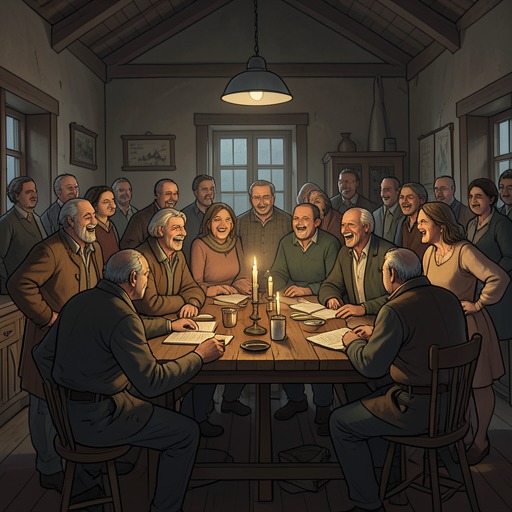
His modesty coexists with a strong interest in how he appears to others. At the shearing supper, when urged to sing, he asks the company to inspect whether his features show that drink has made him blush. Bathsheba’s attention makes him more self-conscious, but the encouragement of the assembled workers persuades him to sing. The scene makes his timidity a social habit as well as a private discomfort: he repeatedly retreats into humility, then accepts the attention that humility attracts.
Poorgrass’s religious language is similarly characteristic. He interprets ordinary events through prayer and Scripture, and his neighbors recognize this piety as one of his defining habits. He says that he asks God’s protection before acting, and he takes pride in being able to recount the prayers and church responses he knows. His faith offers a vocabulary for fear and uncertainty, but it also becomes part of his comic storytelling, as when he remembers trying successive prayers to persuade a gate to open.
Farm Work and Comic Episodes
Poorgrass is a working member of the farm community, not merely its raconteur. When Bathsheba takes charge of the accounts after dismissing her thieving bailiff and declares her intention to manage the farm herself, she questions the laborers about their jobs and wages. Poorgrass explains that he does carting throughout the year, shoots rooks and sparrows in seedtime, and helps with pig-killing. Bathsheba confirms his pay and gives him an additional ten shillings as a newcomer’s present. His awkward exchange with her—he first addresses her as “sir” before correcting himself—places his characteristic deference within the new mistress’s direct management of the workforce.
Among the stories told about him, the most memorable concern getting lost. Once, after working late at Yalbury Bottom and drinking, he loses his way in Yalbury Wood. When an owl calls, he answers that he is Joseph Poorgrass of Weatherbury, though he protests that he never added “sir” to the introduction. His correction is revealing: even while embarrassed by the story, he insists on the exact truth of its wording. On another occasion, unable to open a gate at Lambing-Down Gate, he kneels to pray. He works through the Lord’s Prayer, the Belief, the Ten Commandments, and the service responses he knows; only when he reaches “Saying After Me” does he stand, at which point the gate opens. The neighbors consider the implication together, while Poorgrass presents the episode as both a fearful experience and a providentially resolved one.
The workers’ jokes also make Poorgrass a foil for the more decisive Gabriel Oak. After Oak arrives carrying four newly born lambs from the stables, Poorgrass praises him as a fitting choice for bailiff. Oak acknowledges that he had hoped for the post, but accepts Bathsheba’s right to manage the farm herself. Poorgrass’s praise and Oak’s response show the difference between the men’s positions: Poorgrass can voice the judgment of the laborers, while Oak has the experience and ambition to hold responsibility, even when it is denied him.
News, Work, and the Limits of His Reliability
Poorgrass’s timidity becomes consequential when the flock breaks into a field of young clover. He and the other workers bring Bathsheba alarming news that the sheep may die unless they are removed and treated. Bathsheba immediately abandons her intended departure for church and runs to the field. Poorgrass is among those who raise the alarm, but the episode also shows the risk of his nervousness and the workers’ tendency to talk around a crisis: Bathsheba reproaches them for coming to her instead of acting at once. His presence belongs to the collective failure of judgment, even as his report helps set the rescue in motion.
On another occasion, Poorgrass becomes part of the audience for news that bears on Bathsheba’s relationship with Sergeant Troy. Cain Ball recounts seeing Bathsheba walking arm in arm with a soldier in Bath, but cannot confidently swear to the identification in the grave terms demanded by the workers. Poorgrass presses Cain about the seriousness of an oath, invoking Scripture and the danger of swearing falsely. Gabriel rejects the report as uncertain, while Poorgrass treats the oath as spiritually weighty. The exchange shows how his piety can sharpen a question of truth without resolving it: his insistence on solemn testimony does not make Cain’s recollection more reliable.
Poorgrass also serves as a messenger. When he tells Bathsheba that Fanny Robin has died in the Union-house, he explains that her body is to be returned to Weatherbury for burial and that the parish is legally responsible for her. Bathsheba takes over the arrangements, specifying a clean spring wagon and asking that it be decorated with evergreens and flowers. Poorgrass receives the practical instructions, including the choice of the horse Pleasant, who had known Fanny. The exchange places him between official parish duty and Bathsheba’s personal response: he conveys the circumstances, while she makes the return and burial an act of care.
The Errand for Fanny Robin
Poorgrass is entrusted with bringing Fanny’s body back to Weatherbury, but the journey exposes the gap between the seriousness of the errand and his own weakness of will. On the way, he stops at the Buck’s Head and joins Jan Coggan and Mark Clark for drink. He says he has been traveling with a pale companion and describes the drink as a comfort on his melancholy errand. What begins as a brief pause stretches into the evening; Coggan’s watch strikes six, although Poorgrass had been expected at the churchyard gate earlier. Gabriel arrives and rebukes him and the others for delaying.
Coggan argues that haste cannot help someone who is already dead, and Poorgrass offers his usual appeal to reason through a comic excuse: he says that he has a “multiplying eye,” which makes the others appear doubled. The episode does not cancel the care he had shown in receiving Bathsheba’s instructions; instead, it sets his sense of obligation against the convivial habits of the laborers. His piety and melancholy are sincere, but they do not reliably keep him from drink or distraction. The contrast gives the episode its moral and comic force without making him a villain: the dead woman cannot be helped by speed, yet her return to the parish still deserves to be treated as a duty.
Community, Memory, and Ending
At Greenhill Fair, Poorgrass attends the crowded performance of Turpin’s Ride to York and the Death of Black Bess with Coggan. He is jostled in the crowd, fears that the women around them may be dangerous, and then becomes deeply absorbed in the staged story. When Tom King is apparently shot, he reassures Coggan that the death is only seeming. At the final scene, he helps carry Black Bess’s body out on a shutter and urges Coggan to join him because it will be something to tell about in future years. The narrator later notes that Poorgrass continued to recount how he had touched the horse’s hoof. His participation turns a traveling show into local lore, and the community’s repeated retelling becomes a modest form of immortality for the fictional horse.
Poorgrass remains a village witness at the close of the novel. When the judge travels toward Casterbridge for Boldwood’s trial, Poorgrass joins Coggan and Cain Ball among the Weatherbury people who watch the procession. He studies the judge’s face and thinks he sees mercy in the eye turned toward him, then voices the idea that justice will weigh Boldwood. Yet he also advises the others not to attend the trial, believing their presence would disturb the prisoner. His response combines curiosity, religious solemnity, and a sense of restraint toward another person’s suffering.
After Bathsheba and Gabriel marry, Poorgrass is among the friends who acknowledge the marriage and offer good wishes. He recalls that he had nearly invoked the biblical injunction to leave Ephraim to his idols, but accepts that events have turned out as they have and gives thanks that they might have been worse. The allusion is both comic and generous: he can remember his doubts without allowing them to overrule the community’s present happiness. Poorgrass’s final note is therefore characteristic of his whole role. He interprets events through Scripture, qualifies his judgments with humility, and remains part of the shared life that carries Weatherbury beyond grief and conflict.